
Fillers: the fountain of youth
With so many choices for injectable filler treatments today, it's easy to keep a youthful and natural appearance. But what steps can be taken to ensure these procedures go smoothly with minimal side effects?
At Premier Dermatology, MD we offer the following suggestions to our patients:
Before your treatment:
Bruising is common after treatments. But there are some things that can help minimize it: avoid taking blood thinners such as aspirin, naproxen (Aleeve), ibuprofen (Motrin, Advil), vitamin E supplements, fish oil, garlic tablets, ginko biloba, and ginseng for 7-10 days prior to treatments. Caveat: if a physician has prescribed these for you, do not stop them without checking with the physician first. Arnica tablets, starting on the day of the treatment, may help prevent bruising, as may bromelin (found in pineapples). And it goes without saying to have the treatment done with a board certified core physician (dermatologist, plastic surgeon) with cosmetic experience.
During treatment:
Topical anesthetic cream is applied 30 minutes before the procedure to numb the skin. Since most fillers are pre-mixed with lidocaine (and the ones that aren't can be mixed in the office), the injections themselves should cause minimal discomfort. Applying ice during and after the procedure helps with discomfort and minimizes swelling. Using smaller needles and injecting more slowly helps as well. Proper placement of the filler and physician massage should prevent lumps from forming.
After treatment:
The arnica can be continued to help reduce bruising. It is usually recommended that patients avoid exercise the day of a filler treatment, to help reduce swelling. Sleeping on two pillows helps, too. It's normal to see some swelling for a few days after treatments, especially following lip injections. It's a good idea to follow up with your physician two weeks after the treatment for an evaluation. If there are any concerns, always call your physician. Dr. Bilu Martin's patients can reach her cell phone anytime.
Even though minor side effects can't always be completely avoided, with a little care and planning, they can be minimized. A little bit of filler can make a big impact - with little to no downtime!
Happy Halloween!
Happy Halloween! Time for candy, decorations, and cute little painted faces. What could possibly be wrong with painting your little one’s face?
According to a 2009 report titled "Pretty Scary: Could Halloween Face Paint Cause Lifelong Health Problems?" by the U.S.-based Campaign for Safer Cosmetics, many kids' face paint products labeled as “non-toxic” actually contained toxic products. Ten out of ten face-paint products tested contained lead. Six out of ten contained metals such as nickel, cobalt and/or chromium at higher-than-recommended levels, which commonly cause allergic contact dermatitis. Lead poisoning, we all know, is harmful for brain and nervous system development.
Face paint may cause other skin problems, as well. For children prone to acne, thick makeup may exacerbate or trigger breakouts and clog pores. Other ingredients in the makeup may irritate the skin or cause allergic reactions.
So what’s a health conscious parent to do? Check ingredients of face paint carefully. If you’re unsure, skip it. Many websites have homemade makeup recipes using natural ingredients.
Have a safe and fun Halloween filled with treats!
How a-peeling!
What can brighten dark spots, improve acne, even out skin tone, and treat mild photoaging, but with minimal downtime? Chemical peels!
What kind of peels are available at Premier Dermatology, MD? We offer glycolic acid peels, salicylic acid peels, the Miami Peel, and the Vi peel.
Glycolic acid peels: Contains glycolic acid: an AHA, alpha-hydroxy acid, which is a naturally occurring compound made from sugar. The depth or strength of the peel depends on which concentration is used. 20-50% glycolic acid is a very superficial peel, while 50-70% is a little stronger (deeper), but still considered a superficial peel. Superficial peels affect the very top layers of the skin. There is generally little to no physical peeling with these treatment. These peels are done monthly.
Salicylic acid peels: Contains salicylic acid: a BHA, beta-hydroxy acid. This is a great peel for acne, clogged pores, and oily skin types. These peels are superficial and may result in mild peeling, but overall there is minimal downtime. These peels are done monthly.
Miami peel: Contains hydroquinone, lactic acid, salicylic acid, citric acid, and kojic acid. This peel is good for all skin types, but works especially well for hyperpigmentation and melasma. There is no peeling with this peel, and it can be performed every two weeks for best results.
Vi peel: Contains trichloroacetic acid (TCA), phenol, retinoic acid, and vitamin C. This peel is great for hyperpigmentation, melasma, fine lines, sun damage, improves skin tone and texture. It is safe for all skin types. Skin will peel for 3-5 days following the peel. It can be done monthly. And then? Radiant, healthier looking skin!
Call 305-521-8971 to schedule a complimentary consultation with Dr. Bilu Martin and see which peel is right for you!
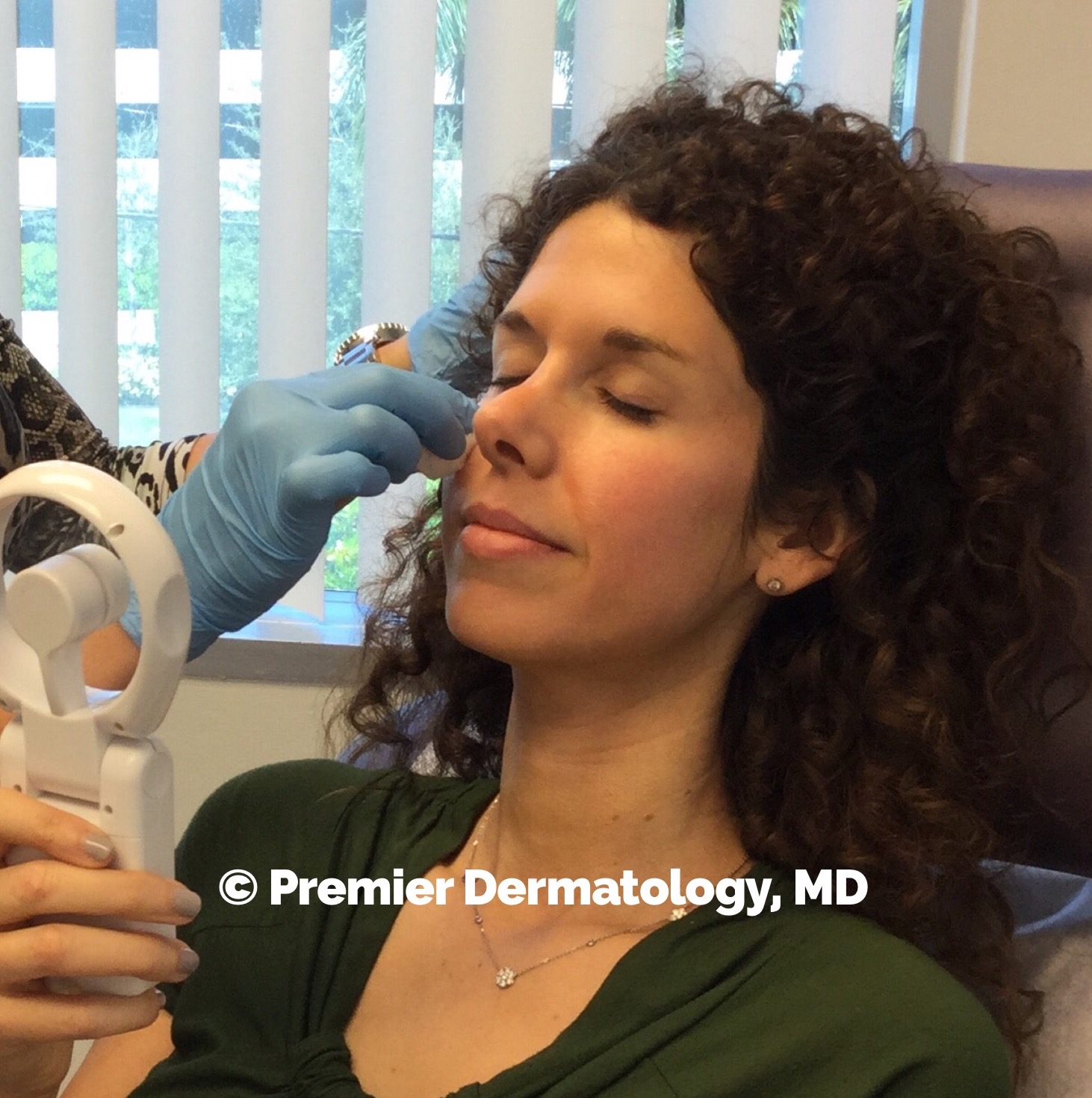
Dr. Billu Martin practices what she preaches: getting her Vi peel!
Itchy and Scratchy
October is Eczema Awareness month. So what is eczema?
At Premier Dermatology, MD, Dr. Bilu Martin sees and treats eczema regularly in babies, kids, teens, and adults. It can be very itchy and is often annoying to patients. In Greek eczema means "to boil over," which refers to the blistering or weepy phase of the disease. Eczema can start in infancy as crusted patches on the scalp, cheeks, bottoms, arms, and legs. Later, as kids get older, it often shows up on the inside of arms and backs of knees. Adults usually develop hand and finger dryness and cracking, which is often painful.
Although there is no known exact cause, it seems to run in families and has a genetic link. The immune system may be more sensitive to certain triggers. Often, asthma and seasonal allergies run together with eczema. People that have two of three of this conditions are called "atopics." They have skin that is easily irritated.
People with eczema are very sensitive to fragrances and chemicals. All soaps, detergents, and moisturizers should be mild and fragrance free. Some good options are dove, cetaphil, cerave, eucerin, and vanicream. Make sure baths and showers are lukewarm, not hot. MOISTURIZING is a must. Moisturize right after coming out of the bath, when skin is still damp. A great choice is aquaphor. It's great for any skin area, as a lip moisturizer, for laser and peel after-care, for wound healing, on areas after biopsies and surgeries, etc. Slather it on. If it seems too greasy to use during the day, put it on at night and sleep with it. For dry, cracked hands, slap on aquaphor and then cotton gloves on top. Avoid soaking hands in water; use gloves when doing the dishes or housework. And certain fabrics, like wool, can be very irritating to atopic skin.
When moisturizing is just not enough, there are prescription steroid and non-steroid creams for the skin, as well as antihistamines that can be recommended by a doctor. Also: raw, scratched areas can easily become superinfected with bacteria and viruses, so it's important to see a dermatologist regularly. Although many kids will outgrow eczema, there are still plenty of adults affected by it. Lucky for us Floridians - summer months are usually better for atopic skin than cold, dry winters.
Are you tired...?
Finally, with any skin condition, taking care of your overall health is essential. Sleeping a full eight hours, eating a healthy diet rich in antioxidants (green tea, vitamin C, vitamin E, resveratrol, acai, blackberry, etc), exercise, and stress relieving activities (yoga, breathing) are vital to a youthful, energized, beautiful, you!
Categories
- November 2014 (1)
- December 2014 (3)
- January 2015 (4)
- February 2015 (3)
- March 2015 (1)
- April 2015 (3)
- May 2015 (4)
- June 2015 (2)
- July 2015 (0)
- August 2015 (1)
- September 2015 (2)
- October 2015 (4)
- November 2015 (1)
- December 2015 (1)
- January 2016 (2)
- February 2016 (1)
- March 2016 (3)
- April 2016 (2)
- May 2016 (1)
- June 2016 (1)
- August 2016 (1)
- October 2016 (1)
- January 2017 (1)
- February 2017 (1)
- June 2017 (1)
- August 2017 (1)
- October 2017 (1)
- December 2017 (1)
- April 2018 (1)
- May 2018 (1)
- November 2018 (1)
- May 2019 (1)
- July 2019 (1)
- January 2020 (1)
- March 2020 (2)
- July 2020 (1)
- November 2020 (0)
- January 2021 (1)
- October 2021 (1)
- January 2022 (1)
- June 2022 (1)
- November 2022 (1)
- April 2023 (1)
- September 2023 (1)
- September 2023 (1)
- December 2023 (1)
- February 2024 (1)
- July 2024 (1)
- September 2024 (1)
- March 2025 (1)
- October 2025 (1)
- July 2026 (1)
- October 2026 (1)
Archives
Latest on blog

Perfect Derma Peel + Dysport = Perfect Match
Published September 29th, 2026Ah, summer. Beach days, cookouts, boat excursions, and outdoor sports. It was a nice, long...
Learn More